New client offer: up to £500 gift voucher on qualifying Design & Build projects · 5% off for the person you refer

West London · W3 8HLmustafareid@gmail.com
24/7 Emergency07360 542683
Ash Villa Development Ltd — Plumbing & Heating Services
07360 542683Request a Quote
Powerflushing · Acton & West London

Cold radiators and anoisy boiler usually meanone thing: sludge.

A full powerflush strips the magnetite and debris out of your radiators, pipework and heat exchanger, then we dose the system with inhibitor and fit a magnetic filter so it stays clean. Warmer rooms, quieter boiler, lower gas bills — done in a day by Gas Safe engineers.

Get My Free Quote 07360 542683

Gas Safe registered · £2M insured · 30+ years in the trade · 24/7 emergency line

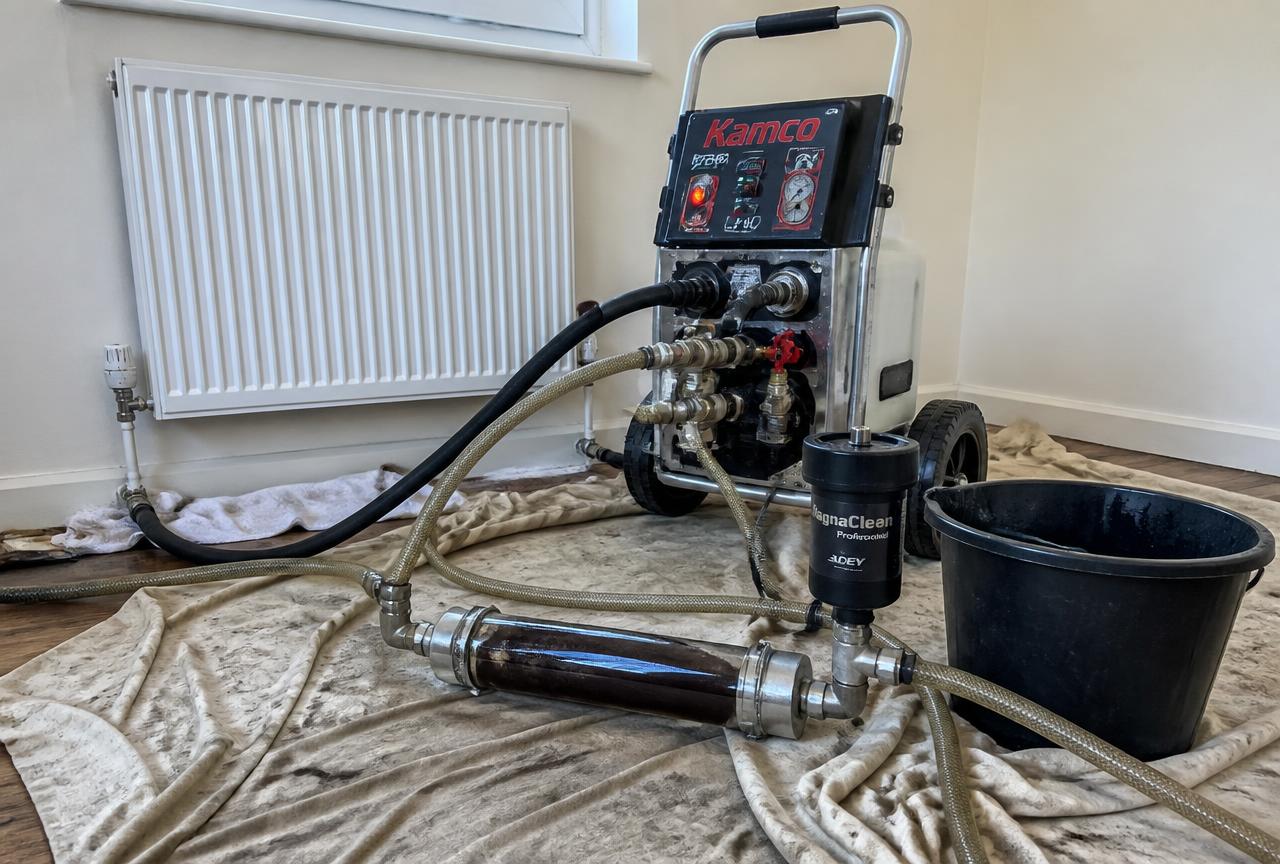
Powerflush machine connected by hoses to a white panel radiator with a magnetic filter and a clear hose section full of black heating sludge, on dust sheets in a West London home — Ash Villa central heating powerflush
30+ Years in the Trade
Gas Safe Registered
Vaillant Approved Installer
£2M Public & Employers' Liability
90-Minute Emergency Response
Service Overview

The plain-English version.

What it is

A high-velocity clean of the whole central heating system. A pump is connected to the circuit and pushes water through the pipework and radiators at speed, with chemical cleanser and reversing flow, lifting out the black iron oxide sludge, scale and installation debris that settle in the bottom of radiators and choke the boiler's heat exchanger.

Who it's for

Homeowners and landlords with a system that has cold spots, a boiler that bangs or kettles, radiators that take an age to warm through, or heating that has been in place ten years or more without ever being cleaned. It's also a condition of most boiler manufacturers' warranties when a new boiler goes onto old pipework.

When you need it

When the bottom of a radiator stays cold while the top is hot, when the boiler makes a kettling or rumbling noise, when the water from a bled radiator runs black, when the system takes far longer to heat up than it used to, or when you're installing a new boiler onto an existing system.

Why use a professional

Sludge is corrosion product — the system is slowly eating itself. It insulates radiator surfaces so you pay to heat water that never reaches the room, it wears out pumps and diverter valves, and it blocks the narrow waterways of a modern condensing heat exchanger, which is the single most expensive part on the boiler.

Left Too Long?

Small problem now.
Big bill later.

The cheapest time to deal with a plumbing or heating fault is almost always now. Water damage, gas issues and system stress compound quickly — the invoice grows with them.

If you leave it

  • Blocked heat exchangers fail. Replacing one on a modern condensing boiler often costs more than half the price of a new boiler.
  • Circulating grit destroys the pump and jams the diverter valve, so you end up with heating but no hot water — usually in January.
  • Radiators heating at half output means the boiler runs longer for the same room temperature, and that shows up on every gas bill.
  • Corrosion perforates radiators from the inside. The first sign is often a pinhole leak onto a floor rather than a warning.
  • Fitting a new boiler onto a dirty system can void the manufacturer's warranty — and the sludge migrates straight into the new heat exchanger within weeks.

Common DIY mistakes

  • Adding inhibitor to a system that is already full of sludge. Inhibitor prevents new corrosion; it does not dissolve what is already there.
  • Repeatedly bleeding radiators to chase air when the real problem is hydrogen gas being produced by corrosion — a symptom, not the fault.
  • Buying a 'chemical flush' and being told it's a powerflush. A chemical clean with no pump and no reversed flow will not shift settled magnetite.
  • Skipping the magnetic filter afterwards, so the system starts silting up again from day one.
  • Powerflushing an old system with visibly corroded microbore or cast iron radiators without inspecting first — dislodging sludge can reveal leaks that the debris was plugging.
Our Process

Predictable. Documented.
Signed off.

You get the same sequence every time — so there are no surprises on the invoice and nothing missed on the job sheet.

  1. 01

    Survey and honest advice

    We check radiator temperature differentials, look at the water from a drain point, and inspect the pipework type. If a flush won't fix your problem — or the system is too far gone to survive one — we tell you before taking any money.

  2. 02

    Protect and connect

    Floors and furniture covered, then the flushing unit is connected across the circulating pump or the boiler tails, with a magnetic filter inline to trap what comes out.

  3. 03

    Chemical clean

    A cleanser is circulated through the full system and each radiator is worked in turn, agitating stubborn deposits so they lift into suspension rather than being pushed further into corners.

  4. 04

    High-velocity flush with flow reversal

    Flow direction is reversed repeatedly to dislodge settled magnetite, radiator by radiator, until the water running out is clear rather than black.

  5. 05

    Neutralise, refill and inhibit

    The system is neutralised and flushed with fresh water, then dosed with a corrosion and scale inhibitor to the correct concentration for the system volume.

  6. 06

    Filter, balance and test

    A magnetic filter is fitted if there isn't one, radiators are balanced so every room reaches temperature, pressure is set and the boiler is checked. You get a written record of what was done.

What You Actually Get

Concrete outcomes,
not marketing fluff.

Rooms that actually get warm

Cold spots at the bottom of radiators disappear once the sludge that was insulating them is gone, so the heat you're paying for reaches the room.

Protects your boiler warranty

Most manufacturers require a clean system and an inhibited fill. We document the flush and the inhibitor dose so your guarantee stands up.

Quieter operation

Kettling, banging and rumbling are usually debris and scale on the heat exchanger. Clear it and the noise goes with it.

Lower running costs

A clean, correctly balanced system reaches temperature faster and cycles less. The efficiency gain is why manufacturers insist on it.

Magnetic filter fitted

We fit a magnetic filter as standard where one isn't already there, so the system keeps catching magnetite instead of circulating it.

One team, one day

A typical West London flat or terrace is a single day's work by Gas Safe engineers who can also handle any repair the flush uncovers.

The Detail

Materials, methods, and where the money goes.

Powerflushing has a bad reputation in some quarters, and honestly some of that is earned — it's been sold as a cure-all for problems it can't fix. Here's a straight account of what it does, when it's the right answer, and when it isn't.

What the black sludge actually is

Steel radiators, water and oxygen produce magnetite — black iron oxide — plus hydrogen gas as a by-product, which is why you keep bleeding radiators that have no obvious air ingress. Magnetite is dense and magnetic, so it settles at the bottom of radiators and gets drawn into the pump and heat exchanger. Add limescale, which West London's hard water contributes freely, plus flux, jointing compound and copper swarf left behind from the original install, and you have a slurry that both insulates radiator surfaces and abrades moving parts. Inhibitor stops the reaction that creates it. It does not remove what is already sitting there — that needs a mechanical clean.

Powerflush, chemical flush and mains flush — the real differences

A mains flush is just clean water pushed through the system; it moves loose debris and nothing else. A chemical clean circulates cleanser using the system's own pump for a period, then drains — better, but at normal circulation speed it won't lift settled magnetite from the bottom of a radiator. A true powerflush uses a dedicated high-flow, low-pressure pump with the ability to reverse flow direction, working each radiator individually, combined with cleanser and usually magnetic agitation. Only the last one reliably clears a badly silted system. If you are quoted a 'powerflush' and no pump unit arrives on the van, you are not getting one.

How to tell whether you need one

Reliable signs: radiators hot at the top and cold across the bottom third; some radiators never heating while others are scalding; black water when you bleed or drain; a boiler that kettles, bangs or rumbles as it fires; a system that has to be re-pressurised often; heat-up times that have crept up over the years. Less reliable: a single cold radiator, which is more often a stuck thermostatic valve pin or simple imbalance, and radiators cold at the top, which is usually just trapped air. We check before quoting — if your problem is a £15 valve head we will say so rather than sell you a day's work.

When a powerflush is the wrong answer

There are systems we advise against flushing. Very old microbore in poor condition can block completely once disturbed. Heavily corroded radiators sometimes leak at the point the sludge that was sealing a pinhole is washed away. Cast iron radiators on gravity systems need different treatment. And where the pipework is genuinely at end of life, the money is better spent on replacement than on cleaning something that will need ripping out inside two years. We would rather tell you that on the survey than halfway through the job.

New boiler installations on existing pipework

Building Regulations Part L requires the system to be cleaned before a new boiler is commissioned, and manufacturers including Vaillant and Worcester make a clean, inhibited system a warranty condition. When we install a boiler onto existing pipework we either powerflush or, on cleaner systems, carry out a documented chemical clean, then fit a magnetic filter and dose with inhibitor. It is not an upsell — it is the difference between a warranty that pays out and one that doesn't, and it protects a brand new heat exchanger from a decade of accumulated debris.

Keeping it clean afterwards

A powerflush resets the system; it doesn't immunise it. Three things keep it clean: a magnetic filter, cleaned at each annual service; inhibitor topped up whenever the system is drained down for a radiator change or a valve swap; and an annual service where the inhibitor concentration is actually tested rather than assumed. Do those and you should not need another flush for a decade or more. Skip them and you'll be back within five years — which is the honest reason we fit the filter and check the dose as part of the job rather than as an extra.

Frequently Asked

The questions we hear on the phone.

Nothing here is generic — these are answers we give West London customers every week.

Ask us directly
How much does a powerflush cost in West London?

It's priced by the number of radiators and the state of the system, so we quote after a short survey. The quote is free and written, and it includes the inhibitor dose and a magnetic filter where one isn't already fitted.

How long does a powerflush take?

A typical flat or two-bedroom terrace is a single day. Larger properties, or systems with heavy sludging and many radiators, can run into a second day. We'll tell you which at the survey rather than on the morning.

Will a powerflush fix my cold radiators?

If the radiators are hot at the top and cold along the bottom, or some never heat at all while others are scalding, then almost always yes — that pattern is classic sludge. If they're cold at the top only, that's air, and if a single radiator is cold it's usually a stuck valve. We diagnose before quoting.

How often should a central heating system be flushed?

A well-maintained system with a magnetic filter and correctly dosed inhibitor should go ten years or more between flushes. Systems with no filter, or that get drained down often for building work, silt up much faster.

Do I need a powerflush before a new boiler?

You need the system cleaned — that's a Building Regulations requirement and a manufacturer's warranty condition. On a dirty system that means a powerflush. On a relatively clean one, a documented chemical clean plus filter and inhibitor may be sufficient. We assess and recommend honestly.

Can a powerflush cause leaks?

It can reveal them. On old or heavily corroded systems, sludge sometimes plugs a pinhole that was already there, and clearing it exposes the underlying failure. That's why we survey the pipework and radiator condition first and tell you plainly if the system is a poor candidate.

Is a magnetic filter included?

Yes — where one isn't already fitted, we install a magnetic filter as part of the job. Without one, the system starts collecting magnetite again immediately and you lose the benefit of the flush.

Will it lower my heating bills?

A clean, balanced system reaches temperature faster and cycles less, so it uses less gas for the same warmth. The saving depends on how bad the system was to start with — we won't quote you a percentage we can't stand behind.

Do you cover Acton and Ealing?

Yes. We're based in Acton W3 8HL and powerflush systems across Acton, Ealing, West Ealing, Ealing Broadway, Ealing Common and the wider West London W and NW10 postcodes.

Do I need to be home for the whole day?

Someone needs to give access and be there at the start and end. Landlords often arrange it with the tenant and we report back with photographs of the water clarity and the filter contents.

Wet room tanking and waterproofing in progress at an Ash Villa Development project in West London
Next Step

Book a free on-site quote.
Get a firm price in 2–3 days.

No pressure, no obligation. A Gas Safe engineer visits, scopes the job in person, and puts a written quote in your inbox — usually within 2–3 working days. For emergencies, call the line — it's answered 24/7 by the team, not a call centre.

Request My Free Quote 07360 542683

Gas Safe registered · £2M insured · 30+ years in the trade · 24/7 emergency line

Keep Exploring

Related pages

HomepageGeneral Plumbing24/7 Emergency PlumbingBoiler InstallationsService areasContact & quotes
Call NowFree Quote

We use strictly necessary cookies to run this site, and optional analytics cookies only if you accept. Cookie policy.